AI Quality Estimation Fails Rare Languages
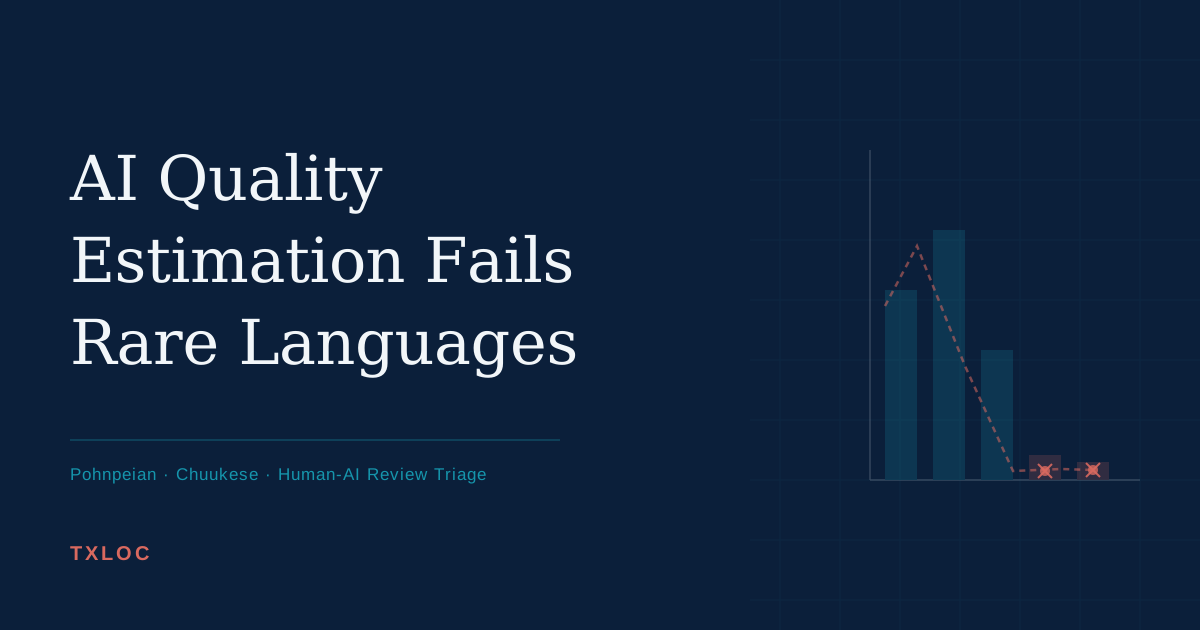
The Gap Nobody in the QE Conversation Mentions
AI quality estimation is genuinely useful. The core idea, as Smartling's guide explains, is straightforward: instead of reviewing every machine-translated segment or blindly publishing all of it, a confidence-scoring model flags the segments most likely to contain errors. High-confidence output moves forward; low-confidence output goes to a human reviewer. Review stops being all-or-nothing.
For high-resource languages — Spanish, French, Mandarin, German — this works well enough to reshape localization economics. The confidence models behind it are trained on billions of aligned sentence pairs, error annotation datasets, and post-edit logs built up over decades.
For Chuukese and Pohnpeian? Those training sets do not exist. And that absence breaks the entire premise of confidence scoring.
How Confidence Scoring Actually Works
A quality estimation model does not compare a machine translation against a correct reference. Instead, it recognizes patterns associated with likely errors: structural anomalies, terminology drift, ambiguous source phrasing, and low-probability token sequences. It assigns each segment a score that predicts how much human editing it will probably need.
The model learns those patterns from data. Specifically, from large volumes of labeled translations showing which segment features correlate with post-edit effort and error rates in a given language pair.
That training data requirement is not a technical footnote. It is the whole mechanism. Remove the training data and you do not get a less accurate confidence score — you get a confidence score that has no meaningful relationship to actual translation quality.
For English-to-Chuukese or English-to-Pohnpeian machine translation, there is no substantial training corpus for a quality estimation model to learn from. There are no large post-edit logs. There are no standardized error annotation sets. The languages are oral-primary, have limited digital text presence, and have received almost no attention from the major MT research community.
A QE model operating on these pairs is essentially guessing. Worse, it may guess with high confidence.
What a False High-Confidence Score Costs
The danger is not that low-quality segments get flagged for review — that is the system working. The danger is that a poorly trained or zero-shot QE model assigns high confidence to a segment that is actually wrong, and that segment publishes without a human reviewer ever seeing it.
In healthcare, that failure mode is not abstract. Consider a Pohnpeian-speaking patient in a Federated States of Micronesia community health context receiving discharge instructions translated by an MT engine with no Pohnpeian-specific quality controls. The QE model scores the segment high-confidence. The segment ships. The medication schedule is wrong.
Chuukese-speaking populations in the US — concentrated in Guam, Hawaii, and parts of the Pacific Northwest — face the same risk when school districts, county health departments, or Medicaid managed care organizations use AI translation pipelines without language-specific review gates.
The volume of content flowing through AI pipelines is growing fast enough that the "we'll catch errors in spot checks" approach is not a quality strategy. It is a hope.
The Only Workable Model for Underserved Language Pairs
For languages where QE training data does not exist, the workflow has to be rebuilt around that constraint. The solution is not to avoid machine translation — MT has genuine utility even in low-resource language pairs for rough drafts and high-volume triage. The solution is to treat every segment as low-confidence by default and build human review into the pipeline as a structural requirement rather than an exception path.
Here is how that hybrid triage model works in practice:
| Stage | High-Resource Language (e.g., Spanish) | Rare Language (e.g., Chuukese, Pohnpeian) |
|---|---|---|
| MT output | Produced by trained engine | Produced by general-purpose LLM or limited MT |
| QE scoring | Model assigns segment-level confidence | No reliable QE model; default all to low confidence |
| Routing decision | Confidence threshold routes to human or publish | All segments route to qualified human reviewer |
| Human review scope | Flagged segments only | Full post-edit by native/heritage speaker linguist |
| Risk tier | Managed by QE model | Managed by workflow rule + human expertise |
This is not a workaround. It is an accurate description of the data reality. Any agency telling you that their QE pipeline handles Pohnpeian with the same reliability as Spanish is either uninformed or not being straight with you.
Why This Matters for Healthcare and Government Buyers
US healthcare systems, school districts, and local government agencies operating under Title VI, Section 1557, or state-level language access mandates cannot treat "the AI scored it high" as a compliance defense. Quality assurance documentation for a limited English proficient population that includes Micronesian language speakers needs to show a human qualified in that language reviewed the content.
Federal guidance from the Office of Minority Health and HHS is explicit that meaningful access requires competent translation. Competence cannot be certified by a confidence score generated from a model with no exposure to the target language.
For language service companies subcontracting rare-pair work, the same logic applies. Your QE workflow may be excellent for the 40 language pairs it was built to serve. It is not adequate for Chuukese or Pohnpeian, and representing it as such creates liability for you and your end client.
The Honest Position on AI Quality Estimation
AI quality estimation is a real improvement for the languages it can actually serve. The routing logic, the reduced review overhead, the shift from volume-based to risk-based review — all of that is genuinely valuable.
But the technology's value is inseparable from its training data. For languages without that data, the only responsible quality assurance approach is human review at every segment, by a linguist with verifiable proficiency in the target language.
If your content touches Chuukese or Pohnpeian speakers, build your workflow around that requirement from the start — before a published error makes the case for you.
If you need a subcontracting partner with qualified linguists in these specific languages, reach out to the TXLOC team to talk through what a compliant review workflow looks like for your project.
Manages the TXLOC platform and content.
Related articles
Why the Orchestrator Model Matters Most in Rare Languages
The Numbers Behind the Shift Traditional human translation dropped from 37% to 29% of language company revenu...
Why More AI Reasoning Doesn't Mean Better Translation
More Thinking Isn't Always Better A study covered by Slator throws cold water on a common assumption bak...
AI Localization Governance Is Now the Hard Part
Production Is Getting Easier. Control Is Getting Harder. At SlatorCon San Francisco in September 2026, eBay S...